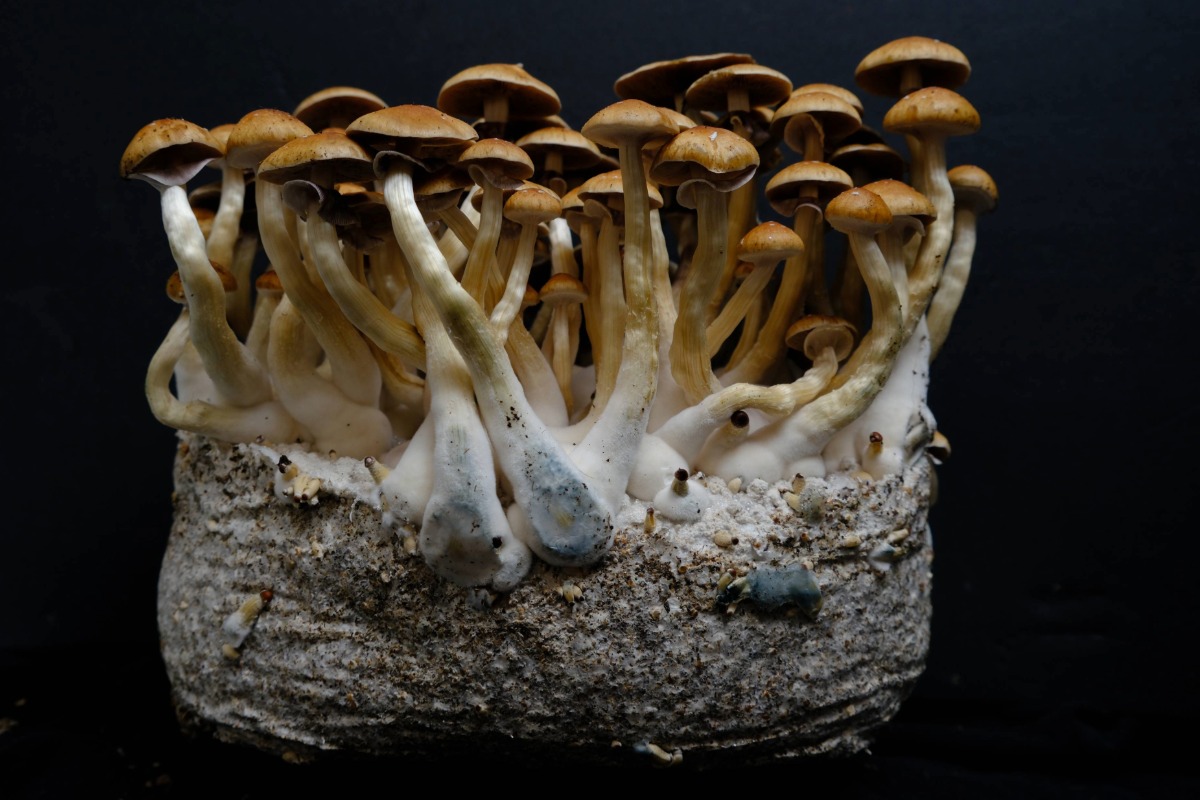
Golden Teacher Mushrooms
You’ve likely seen headlines about ‘magic mushrooms’ in the news, connected to promising research from universities like Johns Hopkins. Or perhaps you’ve simply heard the name “Golden Teacher mushrooms” mentioned in wellness circles and wondered what, exactly, they are. Amid the growing buzz, it’s easy to feel like you’re missing a piece of the puzzle.
Beyond the mystical name, Golden Teachers are a well-known variety of psychedelic mushroom containing the natural compound psilocybin. Think of it like apple varieties; a Granny Smith and a Honeycrisp are both apples, but with different characteristics. Similarly, Golden Teachers are renowned for their reported balanced and insightful qualities, making them a frequent subject of discussion. Not to mention they are by far the fastest mushroom you can research.
This straightforward guide cuts through the hype, covering what they are, their potential effects, and the critical context needed for a safe, educational overview. Our goal is to provide clarity, answering your questions with facts instead of speculation.
What Makes a “Golden Teacher” Different From Other Mushrooms?
You might be wondering if all “magic mushrooms” are the same. The simple answer is no. While many fall under one famous species known as Psilocybe cubensis, there are dozens of different varieties, or “strains,” within that family—and Golden Teacher is one of the most well-known.
Think of it like the difference between types of coffee beans. An Arabica and a Robusta bean will both give you caffeine, but they offer distinct aromas, flavors, and strengths. Similarly, different mushroom strains contain the same active compound, psilocybin, but are anecdotally reported to have different potencies and characteristics. The amount of active content in golden teachers is on the lower side of the spectrum and allows users to ease into their trip without going over the edge. The average potency reading for golden teachers is in .60 % range which is nearly half of the average potency of penis envy for example.
This is where Golden Teachers have earned their name. They are widely regarded as offering a reliable, insightful, and more gentle psychedelic experience. This reputation for a balanced journey often puts them in contrast with other, more intense strains, making the Golden Teacher a frequent and recommended starting point for curious newcomers.
Do Golden Teachers have gold spores? No, they have black spores. Although Golden halo, and columbian rust spores that have bright golden spores. Some exotic magic mushrooms can even produce unique deep red spore prints.
Under magnification, Golden Teacher spores display the typical features of land race Psilocybe cubensis spores:
- Shape: Ellipsoid to sub-ellipsoid
- Size: Approximately 11–17 µm × 7–12 µm
- Color: Purple-black in mass (visible in spore prints)
- Germ Pore: Prominent apical germ pore
The dark purple-brown coloration is a key identifying trait of P. cubensis spores and helps differentiate them from other mushroom species.
The most common magic mushroom beginner reseacher start with is golden teachers because of the ease of research and relaxing effects that are not overpowering. Other golden cap varities have similar research times and effects but do not carry the notority because of the attention the name golden teacher has captured of the years. People really gravitate towards the name and appeal.
Here are the top four land race psilocybe cubensis mushrooms below with slightly different aesthetic differences. ( Golden Teacher, B+, Blue Meanie, and Jedi Mind fuck ) All of these samples were studied via isolated spore syringe with 3 lbs of substrate and 1 lb of grain per bag.
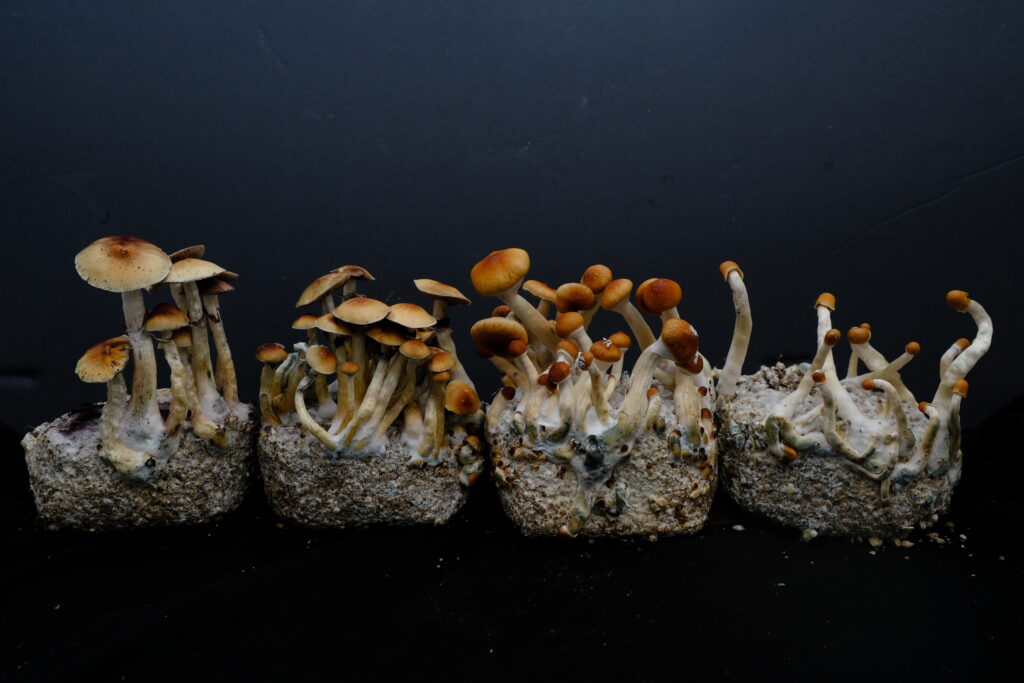
Always keep your spores in the fridge above freezing temperature in a secure zip lock bag. Freezing spore syringes and prints can cause the cells to rupture from cold temperature (Pro tip for storing golden teacher spores)
When stored properly, Golden Teacher spores can remain viable for extended periods. Best practices for long-term preservation include:
- Keeping spores in a cool, dark environment
- Avoiding moisture exposure
- Using sterile, sealed containers
For microscopy purposes, spores are often stored on Reynolds Wrap Pitmaster’s Choice Extra Thick Foil for Grilling, 18 Inch Grill Foil, or within sterile syringes designed specifically for laboratory observation. The Pitmaster’s Choice is the thickest, most effective serving platter for printing Golden Teachers because the foil is sturdy and easy to work with. When you scrape the spores off standard aluminum foil, the blade can easily rip through the aluminum.
The “Engine” Inside: How Psilocybin Affects the Brain
What provides the “teaching” in a Golden Teacher? The mushroom itself is just the delivery vehicle for its primary psychoactive compound, psilocybin. Psychoactive simply means a substance that can temporarily change brain function, affecting things like mood, perception, and thought. When someone consumes a Golden Teacher mushroom, their body gets to work converting that psilocybin into another, more active compound called psilocin.
This is where the experience truly begins. Psilocin interacts with the brain in a way that researchers describe as temporarily altering its communication patterns. Imagine your brain as an orchestra that usually plays familiar songs. Psilocybin acts like a new conductor, encouraging sections that don’t normally play together to create new, unexpected harmonies. This brief shift in brain activity is what gives rise to the profound changes in perspective and perception that characterize the experience.
What Might a Golden Teacher Experience Feel Like?
So, what does that “new music” in your brain actually sound and feel like? An experience with Golden Teachers typically lasts between four to six hours, with the most intense effects peaking in the first few hours before gradually fading. It’s not a single feeling but a journey through a shifting landscape of sensations and thoughts.
While every experience is unique, the effects of Golden Teachers can generally be grouped into three main categories. Understanding these helps demystify what a person might encounter, as many of these feelings can occur at different points throughout the journey.
- Perceptual: Senses may feel heightened. Colors might appear more vibrant, sounds richer, and you may see intricate patterns with your eyes open or closed. Dilated pupils
- Emotional: A wide spectrum is possible, from waves of deep joy and spontaneous giggling to profound feelings of connection and awe.
- Cognitive: Your thought patterns can become more flexible. Many report gaining new perspectives on their life, relationships, or personal challenges.
Crucially, it’s not always a purely positive ride. Moments of anxiety, confusion, or emotional vulnerability are also possible. This is why the context of the experience matters so immensely, which brings us to two of the most important words in the psychedelic world.
The Two Most Important Words for a Responsible Approach: “Set and Setting”
Those two words are “set” and “setting,” a framework that emphasizes how much your internal and external worlds shape a psychedelic experience. Set is short for mindset: your mood, intentions, and emotional state going in. Preparing for a psychedelic experience with a calm, curious, and open mind is considered fundamental, as feelings of high stress or anxiety can become amplified.
Your environment, or setting, is just as critical. This includes your physical location and who you are with. A safe, comfortable, and familiar space, free from unexpected interruptions, contributes to a feeling of security. Think of it like watching a film: a comedy feels funnier with friends in a cozy room, but the same movie might feel unsettling if you watched it alone in a strange, dark place.
Ultimately, set and setting demonstrate that the person and their environment are active participants, not just passive recipients of the mushroom’s effects. This framework of preparation highlights a key truth: the experience isn’t just about what is taken, but how it is approached.
How Dosage Changes the Experience: From Microdosing to Journeys
Beyond your mindset and environment, the final key variable is the amount consumed. Dosage isn’t just a volume knob for the same experience; it fundamentally changes the nature of the effects. The difference between a tiny amount and a moderate one is like the difference between hearing faint music from another room and being at a live concert. The effects, intent, and outcome are entirely distinct.
On one end of the spectrum is what’s known as a microdose. This is a sub-perceptual amount, meaning it’s small enough that it doesn’t produce the classic psychedelic effects like visual patterns or intense emotional shifts. Instead, people who microdose report subtle benefits like improved mood, focus, or creativity over time.
As the dose increases into a low or moderate range, the experience shifts from background support to a noticeable, active event. Colors may seem brighter, sounds richer, and a sense of wonder or deep emotion can emerge. At these levels, the experience becomes more of a dedicated “journey” focused on introspection and new perspectives, underscoring why dosage is such a critical and personal consideration.
An Evolving Landscape: Legality and Research
The conversation around Golden Teacher mushrooms is shifting from a tangle of myths to a more nuanced discussion. With this clearer picture, you can better understand the complexities of psilocybin, from ongoing research to the evolving legal landscape.
While psilocybin remains federally restricted in many places, a critical lens is the most powerful tool for separating fact from hype as scientific and legal perspectives continue to change.
Key Takeaways
- Golden teacher mushrooms are a solid choice for beginner mushroom researchers and easy to find within legal microscopy markets
- The effects of golden teacher are friendly and great microdosing
- Easy to spore print with heavy loads of dark purple black spores .
- larger doses of golden teachers can produce profound effects and spiritual awakening.