

Tidal Wave Mushroom: Genetic Stability, Origins & Future Insights
Disclaimer: This article is intended for educational and microscopy research purposes only. Spore products sold by Lablink Supply contain no psilocybin or psilocin and are sold strictly as specimens for taxonomic study where legally permitted.
The Tidal Wave mushroom has become one of the most talked-about genetics in the Psilocybe cubensis spore community — not because it’s easy to grow, but because it refuses to behave. Where most cubensis strains settle into a predictable pattern after a few generations, Tidal Wave keeps mutating, shifting, and throwing curveballs at growers and researchers who study it under the microscope. That instability is exactly what makes it such a compelling subject for genetic study.
In this guide, we’ll walk through where the Tidal Wave mushroom came from, why its genetic code is so unstable, how it compares to other well-known cubensis varieties like Penis Envy, B+, and Golden Teacher, and what microscopists and spore collectors should know before adding it to a collection.
Who Created the Tidal Wave Mushroom Strain?
Doma is the name of a popular mycologist who created the Tidal Wave Psilocybe cubensis mushroom variety. Magicmyco has been his alias for years and the myco community has long praised his high-potency mushroom genetics for over a decade. Doma has made it his life mission to spread awareness and break myths through testing and data collection in search of new mycology standards.
Doma’s interest in mycology didn’t start as a hobby. He survived a near-death experience in 1998 that led to years of chronic pain and a long battle with opioid dependency as part of his medical recovery. By 2016, his research into mushroom genetics had become both a scientific pursuit and a personal one, and that dual motivation — curiosity paired with lived experience — is part of why his genetics, including Tidal Wave, carry such a devoted following in the spore community today.
How did the tidal wave first appear?
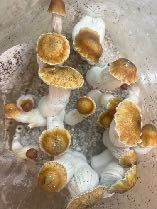
Tidal wave was first established in 2017. The second Filial generation F2 of tidal wave was referred to as TWE or Tidal Wave Eclipse because the day it produced fruiting bodies was the great American solar eclipse in 2017. Doma crossed the B+ with Penis Envy originally acquired by Hawkeye, a vendor who produced viable spores back in the day. The amount of instability in the Tidal wave spores makes them a unique roller coaster ride for most growers since they have been noted to take on many different formations and mutations can occur along the way. The genes that were shared by the B+ could be the potential reasoning behind its unstable character since B+ is known to come from the “hat” in the B+ hat’s isolated features. Sometimes B+ produces a nipple-like hat at the top of the caps and can be slower growing than its counterparts. (GT, Blue Meanie, PF Classic)
How Did the Tidal Wave Mushroom First Appear?
The Tidal Wave strain was first established in 2017, the result of a deliberate cross between B+ and Penis Envy genetics, the latter originally sourced from a vendor known as Hawkeye. The timing of that first cross turned out to be historic in its own right: the second filial generation (F2) of Tidal Wave produced its first fruiting bodies on the same day as the Great American Solar Eclipse of 2017. That coincidence is why this generation became known as Tidal Wave Eclipse, or TWE.
What sets Tidal Wave apart from almost every other cubensis cross is just how unstable its genetic code turned out to be. Rather than stabilizing into a consistent phenotype after a generation or two, Tidal Wave continues to throw new formations, structural quirks, and outright mutations across subsequent generations. Much of that volatility is believed to trace back to the B+ side of the cross. B+ itself is known for its variable “hat” — the cap of the mushroom sometimes develops a distinctive nipple-like protrusion at the top, and B+ tends to grow more slowly than siblings like Golden Teacher, Blue Meanie, or PF Classic. When that already-variable genetic material was combined with the dense, deformed structure typical of Penis Envy, the result was a strain that essentially never stopped evolving.
Where Did the Tidal Wave Mushroom Go Next? Meet the Enigma
Genetic instability didn’t stop with the first generation. In 2018, a second wave of mutations produced what the community now calls the Tidal Wave Enigma, or TW2. Compared to the original Tidal Wave, the Enigma mushroom is slower to fruit and noticeably stranger in form, developing the coral-like, brain-like structures that have made it one of the most recognizable (and most photographed) cubensis isolations in the hobby.
The Enigma’s reputation isn’t just about appearance. It was, at the time of its emergence, considered the most potent strain documented within the cubensis family. One theory among growers is that the Enigma’s extended growth cycle — reportedly more than three weeks longer than Penis Envy — gives the organism more time to chemically develop higher concentrations of its signature compounds before fruiting completes. The unusual structure and long development time gave the Enigma an almost mythical status for years. A piece of community folklore even held that “you cannot morally sell this variety — it must be gifted from one grower to another.” That gifting-only tradition held for roughly seven years, until around 2022, when commercial spore vendors began offering it more widely.
Why Mycologists and Microscopists Care About Tidal Wave Genetics
For anyone studying fungal taxonomy, spore morphology, or genetic drift in cultivated organisms, Tidal Wave is an unusually rich subject. Most cultivated cubensis lines are selectively stabilized over successive generations specifically to eliminate variability — growers want predictability. Tidal Wave does the opposite. Its tendency to mutate generation after generation makes it a living case study in genetic instability, hybrid vigor, and phenotypic expression within a single cubensis lineage.
That’s also what makes Tidal Wave spore syringes and spore prints a popular choice among microscopy hobbyists. Because the strain hasn’t fully stabilized, no two slides look quite the same. Spore size, shape clustering, and print density can all vary noticeably between batches — which is exactly the kind of variability a serious microscopy collection benefits from documenting.

Your first genetics are on us.
Subscribe to our newsletter to get a free spore syringe.
Tidal Wave vs. Other Popular Cubensis Strains
If you’re trying to decide which spore genetics belong in a research or microscopy collection, it helps to see how Tidal Wave stacks up against three of the most widely studied Psilocybe cubensis varieties: Penis Envy, B+, and Golden Teacher.
Tidal Wave vs. Penis Envy
Penis Envy is one of the actual genetic parents of Tidal Wave, so the comparison is a direct lineage study. Penis Envy is known for its thick, dense, often misshapen fruiting bodies and a slow, demanding growth cycle. Tidal Wave inherited some of that density and structural irregularity, but layered B+’s instability on top of it, producing far more phenotypic variation from one fruiting cycle to the next. Where Penis Envy is prized for relative (if difficult) consistency once dialed in, Tidal Wave is prized for the opposite — its unpredictability is the point. Under the microscope, Penis Envy spores tend to show more uniform clustering, while Tidal Wave samples often show more visible variance batch to batch.
Tidal Wave vs. B+
B+ is the other genetic parent of Tidal Wave and is widely considered one of the most beginner-friendly, fast-colonizing cubensis strains available, which is part of why it’s been crossed into so many other lines over the years. B+ is comparatively stable and easygoing, with the well-documented “hat” cap variation being its main quirk. Tidal Wave takes that single quirky trait and amplifies it across the entire genome, resulting in a strain that almost never produces a “standard” cubensis fruiting body. If B+ is the dependable baseline, Tidal Wave is what happens when that baseline genetic stability is deliberately broken.
Tidal Wave vs. Golden Teacher
Golden Teacher isn’t part of Tidal Wave’s direct lineage, but it’s the most common reference point growers use because it’s the closest thing the hobby has to a universal standard. Golden Teacher is famous for being highly stable, forgiving for first-time growers, and visually consistent from flush to flush. Tidal Wave is essentially Golden Teacher’s opposite number: unstable rather than stable, structurally unpredictable rather than uniform, and far more interesting as a genetic research subject than as a beginner project. Growers and microscopists often keep both in a collection specifically because they sit at opposite ends of the stability spectrum.
| Trait | Tidal Wave | Penis Envy | B+ | Golden Teacher |
|---|---|---|---|---|
| Genetic stability | Highly unstable, mutates across generations | Moderately stable once isolated | Stable, beginner-friendly | Very stable, considered a baseline strain |
| Growth speed | Slower; Enigma form notably slower | Slow | Fast | Moderate |
| Fruiting body structure | Highly variable, coral-like in Enigma form | Dense, thick, often deformed caps | Classic cap with occasional “nipple” top | Classic, consistent golden-capped cap |
| Best suited for | Genetic research, microscopy, and experienced collectors | Experienced growers, isolation projects | Beginners | Beginners and teaching/reference collections |
| Community reputation | Mythologized, “Enigma” lore | Cult favorite for density and structure | Reliable workhorse strain | The standard reference strain |
How Potent Is the Tidal Wave Mushroom?
Potency in this context refers to documented compound concentration data Doma collected using HPLC and PCR testing rather than anecdotal reports. At the time the Enigma (TW2) generation emerged, it was reported within the community as the most potent cubensis isolation documented up to that point. The leading theory tying potency to genetics is the extended growth cycle: because the Enigma takes substantially longer to complete fruiting than faster strains like B+ or even Penis Envy, the organism may have more time to develop higher concentrations of its signature compounds before the fruiting cycle finishes. It’s worth noting that potency reporting within the spore community is based on grower-shared lab data rather than centralized, peer-reviewed clinical studies, so figures should be treated as community-documented rather than formally regulated.
Is Tidal Wave Good for Microscopy?
Yes — and for a specific reason. Most microscopy hobbyists build collections around strains chosen for clean, consistent, easily reproducible slides (Golden Teacher is a common reference standard for exactly this reason). Tidal Wave serves a different purpose. Because its genetics haven’t stabilized, spore samples from different batches, generations, or even different fruiting flushes can show visibly different spore clustering, size distribution, and print density. For anyone studying phenotypic variation, hybrid genetics, or generational drift in fungal taxonomy, that instability is a feature, not a flaw. It’s part of why Tidal Wave spore prints and syringes remain popular study specimens even outside the cultivation hobby.
Where Is the Tidal Wave Mushroom Strain Headed Next?
The mycology community continues to treat Tidal Wave less like a finished product and more like an ongoing experiment. Through continued spore dilution, isolation, and recombination work, new cubensis varieties with novel potency profiles and structural traits are likely to keep emerging from this lineage, much the way Tidal Wave itself emerged from B+ and Penis Envy. Doma’s winning entries at psilocybin cup events have only intensified community interest, and the gifting culture that once surrounded the Enigma reflects just how seriously growers take the responsible stewardship of unstable, high-value genetics.
For collectors, educators, and microscopists, that ongoing instability is exactly the appeal. A strain that keeps changing is a strain that keeps teaching you something new every time you put a slide under the lens.
Tidal Wave is a Psilocybe cubensis variety created by mycologist Doma (Magicmyco) in 2017 by crossing B+ and Penis Envy genetics. It’s known for unusual genetic instability, meaning its fruiting bodies and spore characteristics continue to mutate and vary across successive generations rather than settling into one predictable form.
According to community-documented HPLC and PCR testing by its creator, the second-generation Tidal Wave Enigma (TW2) was, at the time of its emergence, considered the most potent cubensis isolation documented in the hobby. Its extended growth cycle compared to strains like B+ or Penis Envy is the leading theory for why potency levels run higher.
Yes. Because Tidal Wave’s genetics are unstable, spore samples show more batch-to-batch variation in clustering, size, and print density than stable reference strains like Golden Teacher. That variability makes it a useful specimen for studying phenotypic drift and hybrid genetics under the microscope.
Tidal Wave Eclipse (TWE) refers to the original 2017 F2 generation, named for the solar eclipse that coincided with its first fruiting. Tidal Wave Enigma (TW2) is a later, 2018 generation that mutated further into slower-growing, coral-like fruiting bodies with reportedly higher potency.
Golden Teacher is prized for genetic stability and consistency, making it a common beginner strain and reference standard. Tidal Wave is its near opposite — unstable, structurally unpredictable, and better suited to experienced collectors and microscopy researchers than first-time growers.
B+ is one of Tidal Wave’s two parent strains, and B+ already carries a known quirk: a variable “hat” formation on the cap. Many growers believe that this inherent B+ variability, combined with Penis Envy’s dense structure, is part of what drives Tidal Wave’s ongoing genetic instability.
Lablink Supply offers isolated spore syringes, spore prints, and grow kits for educational and microscopy use. All products are sold strictly as taxonomic specimens, where permitted by law, and contain no controlled substances.